Step-by-Step Guide: Registering Your DNA with the Korean National Police Agency Missing Persons Database for Birth Family Search


Due to the falsification in Korean adoption records, USKRG strongly urges all adoptees to submit their DNA to all available databases. If your records have no birth family information, DNA may be your best hope for finding birth family. If you are in reunion, DNA can verify your genetic relationship.
This guide is split into 3 sections:
Adoptees whose adoption records do not include any birth parent information, may submit their DNA to the Korean Police Missing Persons Database. Adoptees whose birth family information is too limited for them to be found by NCRC (National Center for the Rights of the Child) may also submit their DNA to the Korean Police's database. Instructions are below in the second section.
Background Information
Since 2004, the Korean National Police Agency has been operating the “DNA Analysis Project.” This project compares genetic information between missing children and their families to verify biological relationships. This database has also been called the “Korean Government DNA Database” by some adoptees. However, that is a misnomer. If you provide your DNA “to the Korean Government” your DNA is going into the Police’s Missing Person’s Database.
Korean biological parents and siblings may submit their DNA to the database to search for a missing family member. Only adoptees who do not have any birth parent information in their adoption papers may submit their DNA to the database. This DNA collection and testing is based on Article 11 of the “Act on the Protection and Support of Missing Children'. According to the law, the target group is limited to missing children and their families. This is why only adoptees without birth parent information may provide their DNA. If you have birth parent information, you are not considered to be “missing. Adoptees whose birth parents information is inaccurate or insufficient to identify or locate them may also be eligible.
The USKRG, along with other Korean Rights Groups, are advocating for: DNA testing to be available to all adoptees due to the falsification of information in our records; allowing extended biological family members to submit their DNA to the database; adoptee DNA samples to be compared to all KNPA databases, not just the Missing Persons database.
How to Register Your DNA with the Korean Police Missing Persons Database
Before You Begin
You should check the adoption records. If your records include identifying information about your biological parents, you may not be eligible and NCRC may deny your application.
If your records include identifying information (even if it is redacted) you should apply to NCRC for Adoption Information Disclosure. If NCRC has your birth parents information, they will attempt to make contact to get permission to share their information with you for a possible reunion. If you have already gone through this process and NCRC was not able to make contact with your birth parents, proceed with these instructions.
Request a Certificate for DNA Testing from NCRC
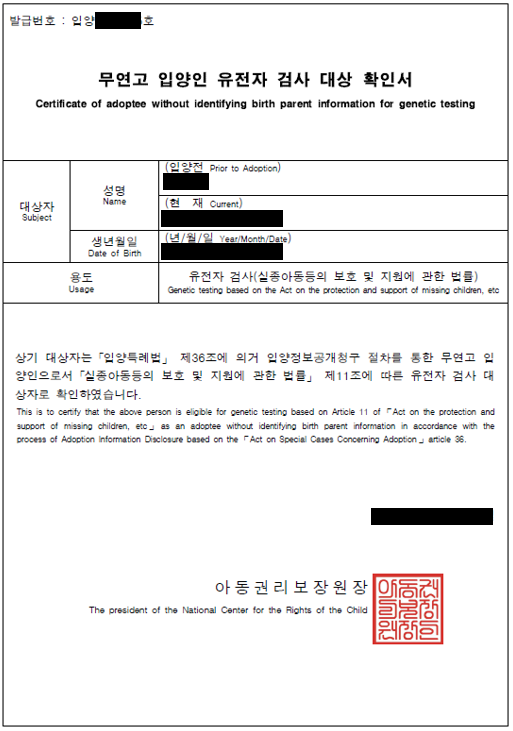
To submit your DNA sample, you will need a Certificate for DNA Testing from NCRC, which verifies to the testing entity that you are an adoptee eligible to give a DNA sample.
To request a certificate, send an email to familysearch@ncrc.or.kr. You will need to attach 4 items to that email:
Application Form – Download from NCRC’s site.
Consent Form – Download from NCRC’s site.
Adoption Record that shows birth parents unknown.
At the time of writing, some pages on NCRC’s site say that you need to provide this. We suggest including it to prevent unnecesarily slowing down the process.
If you have birth family information, but NCRC was unsuccessful in making contact, we recommend you provide information regarding this failed attempt.
Copy of your valid govenment issued photo ID, such as your U.S. Passport.
Application Form Consent Form
You can provide your DNA sample at a Korean Consulate in the U.S. or at a police station in Korea. If you choose to provide your sample in the U.S., you will need to enter the Consulate of your choice on the Application Form.
US Consulate Locations
800 E. Dimond Blvd.
Suite 3-695,
Anchorage, AK 99515
907-339-7955
229 Peachtree St.
Suite 2100
International Tower
Atlanta, GA 30303
404-522-1611
300 Washington St
(One Gateway Center)
Suite 800
Newton, MA 02458
617-641-2830
NBC Tower Suite 2700
455 North Cityfront Plaza Dr
Chicago, Il 60611
312-822-9485
14001 Dallas Parkway
Suite 450 (4th Floor)
Dallas, TX 75240
972-701-0180 x2
2756 Pali Highway
Honolulu, HI 96817
808-595-6109
1990 Post Oak Blvd #1250
Houston, TX 77056
713-961-0186
3243 Wilshire Blvd
Los Angeles, CA 90010
213-385-9300
460 Park Ave, 9th Floor
New York, NY 10022
646-674-6000
1500 John F. Kennedy Blvd
Suite 1830 (28th Floor)
Philadelphia, PA 19102
267-807-1830
3500 Clay Street
San Francisco, CA 94118
415-921-2251
115 W Mercer St
Seattle, WA 98119
206-441-1011 x4
South Korea Embassy
2450 Massachusetts Avenue N.W.
Washington, D.C. 20008
202-939-5653
NCRC Will Verify Your Information
NCRC will verify that the information you provided in your application documents is accurate and that you are eligible to provide a DNA sample. Note that the wait time may be lengthy due to the amount of adoption related requests that NCRC must process and the low number of employees who are assigned to address adoptee requests.
In one instance we are aware of, an adoptee had to wait four months to receive their Certificate. During that time, she sent polite reminder emails to NCRC to ensure that her request did not fall through the cracks.
Receive Certificate
If NCRC confirms you are eligible for submitting your DNA, they will email a PDF of the certificate to you. If you had stated that you will provide your DNA sample at a Consulate, NCRC will also provide informtion to you about the next step. Typically they will notify that Consulate on your behalf that you are eligible for the DNA test. You do not need to contact the Consulate at this time.
If NCRC states that you are not eligible because you have known biological parent information, we advise that you submit a request to NCRC for Adoption Information Disclosure to request your birth parents information. This will prompt them to attempt to make contact with your birth parents to gain their consent to provide their information to you. If you had previously done this, we advise that you inform NCRC that it is their responsibility to either make contact with your birth family and get consent for reunion. If they are not able to make contact, they must approve your request for the DNA Certificate.
Provide the DNA Sample

If you are providing a sample in the U.S., the Consulate you chose will contact you to schedule an appointment to provide your sample. On the appointed date, bring your certificate for DNA testing and your valid photo ID.
If you are providing a sample in Korea, you may visit any Police Station. We recommend visiting a larger station in one of the larger cities, as they will likely be more familiar with the process. Be sure to bring your certificate for DNA testing and your valid photo ID.
Note that the experience at the Consulate may vary. Some Consulates have a much higher frequency of requests for DNA sample processing and therefore are more likely to be familiar with the process.
What’s Next?
Your sample will be sent to the National Forensic Service for processing. If there is a match, the KNP will notify you via email. It is likely that you and the matching person will both need to provide another sample for testing to verify the match. If the second sample is also positive, steps will be taken to initiate connecting you with your match.
If there is not a match, you will be notified by the Korea National Police. Your DNA will remain in the database for cross checking with future DNA sample submissions.
Other DNA Databases for Registering Your DNA
Commercial DNA tests had become popular in the United States because they enabled people born in the U.S. to verify country(s) of origin for their ancestry. Koreans know they are Korean. And due to the family register system, they also know who their ancestors are. Therefore, DNA testing among the general public has not been popular enough to foster a large DNA company.
We recommend that you take 23&Me and Ancestry. Although these tests are not commonly taken in Korea, it is possible to find extended family, who are living in Western countries and more likely to take these tests. Some adoptees have found biological siblings who are also adoptees through these tests. Some adoptees have found extended family such as second cousins. A connection like this can be close enough to lead to finding birth parents.
You can download your raw DNA data from either of those companies and upload them to other DNA databases. FamilyTree DNA* (FTDNA), GED match and My Heritage are smaller DNA databases who will allow you to create an account and upload your DNA for free.
325Kamra is a non-profit organization whose mission is to reunite Korean families to adoptees through DNA. They are in Korea gathering DNA samples from potential birth parents. And they provide low-cost DNA testing kits (from FTDNA) to adoptees. Note that you can upload your DNA to FTDNA for free if you get your data from 23&Me or Ancestry. Because of 325Kamra’s amazing work, FTDNA’s Korean genetic database is growing!


